
TravelTime Location API
TravelTime vs.
TomTom

Looking for a TomTom API alternative? Explore how TravelTime compares to TomTom’s location APIs, so you can make an informed decision when choosing your journey time and location intelligence provider.

Compare TravelTime vs. TomTom on pricing, privacy, coverage, and features — and make an informed decision today.


TLDR: Our overview
- TomTom and TravelTime both offer location technology solutions. But their focus and commercial models are very different.
- TomTom is well known for its navigation engine, live traffic features, and large journey times, frequently embedded in car systems. It’s a fit for in-vehicle use and navigation tasks but comes with restrictive data licensing and usage-based pricing.
- TravelTime is purpose-built for spatial analytics and location matching, helping businesses answer location questions based on journey time across multiple transport modes, at global scale, with a simple fixed-fee pricing model.
What’s the difference between TravelTime and TomTom?
TravelTime and TomTom both operate in the location technology space, yet they serve different purposes. The differences between them can have a major impact on your decision-making, depending on your use case.


USP
Unlimited API usage for one fixed price, public transport data and high-quality support as standard
Live traffic and navigation engine used in car systems
Countries coverage
Global coverage (excl. China, Russia, North Korea)
~55 countries
Privacy
No data collection or tracking
Usage-related data can be collected by TomTom
Licensing
Freedom to cache data, use in AI modelling, and more
Caching or storing of any data is generally prohibited
USP

Countries coverage
Privacy
Licensing
Pricing model
TravelTime or TomTom?
Distance Matrix comparison
Usage limits, response details, and more
Usage limits
Commercial model
One fixed custom price for unlimited API requests
$2.85 per 1,000 transactions
Included in all licences
Only on Enterprise plans

-
Response details
Transport mode
-
-
-
-
Time settings
-
Integrations
TravelTime or TomTom?
Isochrone comparison
Usage limits, transport modes, and more
Usage limits
Model
One fixed custom price for unlimited API requests
$0.85 per 1,000 isochrones
Included in all licences
Only on Enterprise plans
-
Transport mode
-
-
-
-
-
Shape formats
Shape details
-
-
-
Time settings
-
Catchment time
Integrations
Isochrone shape detail
Compare driving isochrones in New York, USA by TomTom and TravelTime
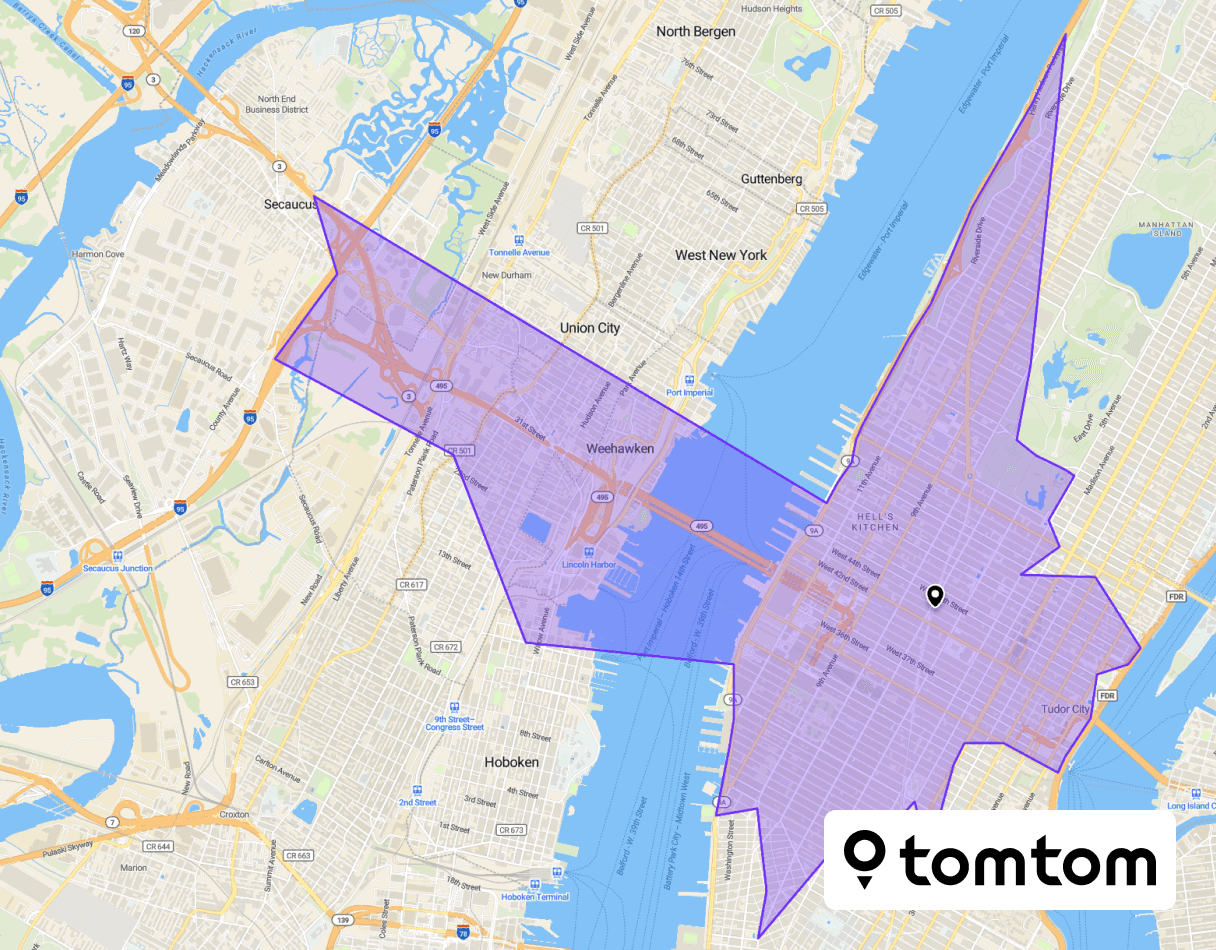
TomTom isochrones are limited in shape flexibility. They offer basic drive-time areas with no support for cycling, walking, or public transport, and no ability to configure shape detail or control edge complexity.
TomTom specialises in navigation but has restrictions beyond this e.g. catchment analysis or scheduling.
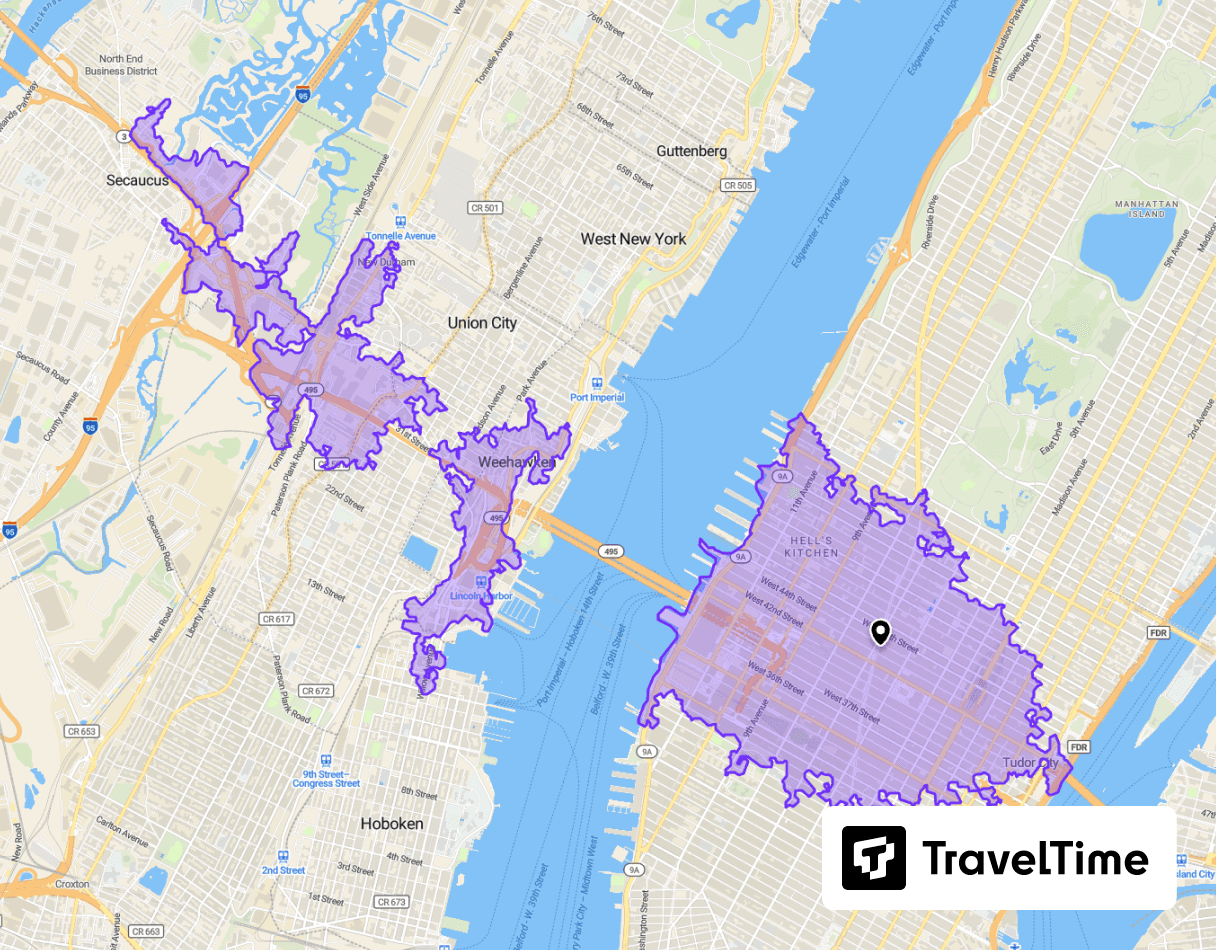
TravelTime isochrones are fully configurable. You can control shape resolution, choose union or intersection outputs, and include multiple transport modes — including public transport.
The result is more accurate polygons for real-world accessibility analysis.
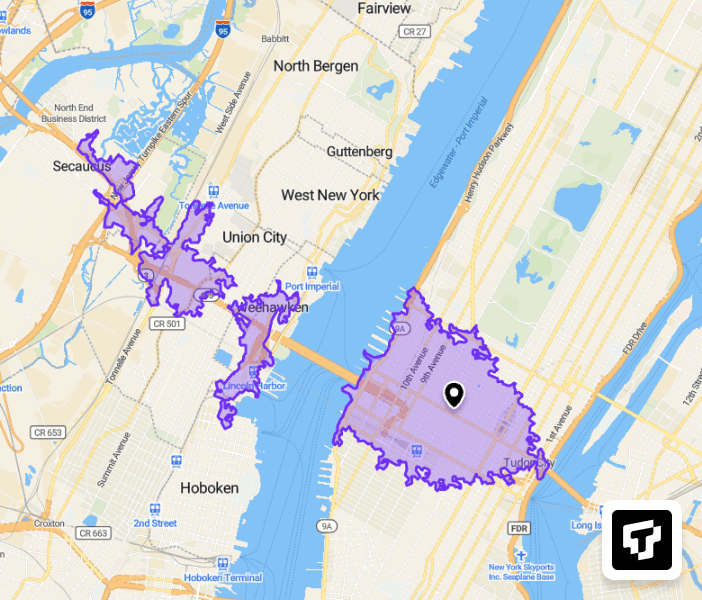
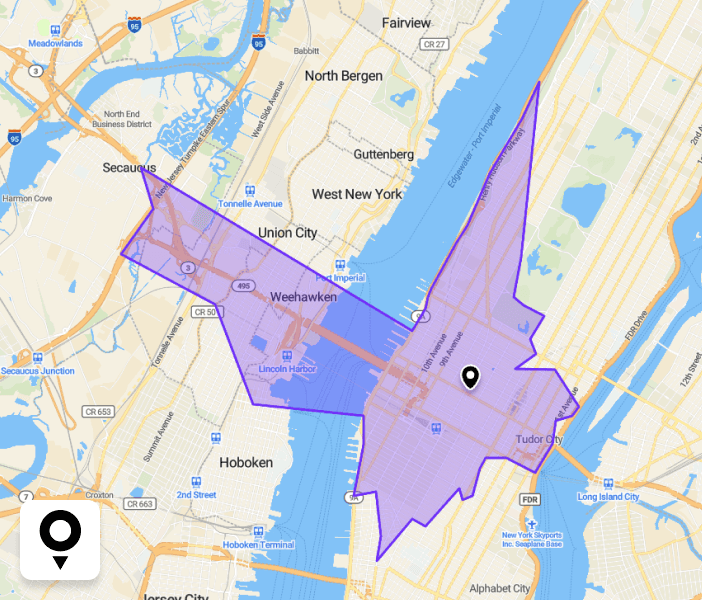

TomTom isochrones are limited in shape flexibility. They offer basic drive-time areas with no support for cycling, walking, or public transport, and no ability to configure shape detail or control edge complexity.
TomTom specialises in navigation but has restrictions beyond this e.g. catchment analysis or scheduling.
TravelTime vs. TomTom:
Transparent pricing that scales
With TravelTime, you pay a flat annual fee for unlimited usage, ideal for growing and large scale businesses. No throttling, no surprises.
TomTom uses a per-call pricing model, which can add up fast and comes with usage limits.
- Fixed cost per year
- Unlimited API calls
- No quotas or throttling
- Pay-per-use pricing
- Steep increases at scale
- Rate limiting and quotas apply
TravelTime vs. TomTom
public transit
TravelTime supports multimodal routing with public transit, walking, cycling, and more as standard.
TomTom offers no public transit coverage and limited multimodal functionality. But it does have HGV models.
Comparing TravelTime vs.
TomTom drive time accuracy
Both TravelTime and TomTom can integrate driving times into your location-based application. They are largely consistent with the other location tech players.
TravelTime’s dedicated data team continuously test and update the algorithms to deliver the most accurate results possible.
Enter two addresses to calculate the drive time.

Drive times calculated using a 12pm midweek departure time (where possible based on each provider). For more details see comparison code.
TravelTime: Privacy
you can trust
TravelTime doesn’t collect, track, or share any user data. Your queries stay private, and we focus purely on delivering accurate and scalable travel times.
In contrast, TomTom may collect usage-related data as part of its service delivery.

TravelTime or
TomTom?
Real support from day one
TravelTime provides high-touch support included with all licences — personalised onboarding, expert guidance, and human support throughout your journey.
TomTom’s support is only available on Enterprise plans.
Switch to TravelTime
Try TravelTime, a TomTom alternative, built for accurate data and scalability.
It’s the first location API provider to promote fair, non-transactional pricing, making it a great choice for large enterprise and high-growth businesses.

Fixed price, unlimited usage

Larger travel time matrices
Best-in-class accuracy
TravelTime and TomTom
Location API FAQs
Yes. TravelTime offers a powerful alternative to TomTom, especially for businesses that need accurate journey time analysis across multiple transport modes, not just driving. TravelTime is ideal for catchment analysis, site planning, and multimodal accessibility, with transparent fixed pricing and no usage limits. TomTom is best for large scale automotive needs.
Transport modes: TravelTime supports walking, cycling, driving, and public transport. TomTom is focused on driving.
Licensing: TravelTime allows full data reuse and caching. TomTom restricts storage and usage.
Pricing: TravelTime offers unlimited usage at a fixed price. TomTom is pay-per-call, with added restrictions and potential overages.
Shape control: TravelTime lets you configure isochrone shape complexity and unions/intersections. TomTom does not.
Isochrone size: TomTom offers isochrones with huge time limits for driving, but they are less configurable than TravelTime.
TravelTime integrates into any app where location plays an important part of any process on the end-user or customer site. It is ideal for:
- Site selection
- Commute analysis
- Logistics and service areas
- Accessibility mapping
- Real estate and retail analytics
- Matching on online marketplaces, for example, property portals and job boards
Build without compromise
Get started with the leading location API today